Updated: May 2026
What is the Best Time for an Electric Yacht Trip to Raja Ampat?
- Seas are at their calmest, ensuring smooth, silent cruising and access to remote coves.
- Underwater visibility is at its peak, frequently exceeding 30 meters for unparalleled diving and snorkeling.
- It coincides with the peak aggregation of Manta Rays at iconic cleaning stations.
A Silent Overture in the Coral Triangle
The air is thick with the scent of salt and damp earth. Aboard the deck, the only sound is the gentle lapping of turquoise water against the hull and the distant cry of a Papuan hornbill from a limestone karst island that erupts vertically from the sea. There is no thrum of a diesel engine, no shudder of machinery—only the near-silent hum of electric propulsion guiding us through the Dampier Strait. This is the overture to a journey in Raja Ampat, an experience where the vessel is not merely a mode of transport, but an integral, silent participant in the natural world. The question of when to visit this last paradise is less about finding a window of good weather and more about aligning your desires with the subtle, cyclical rhythms of the archipelago. It’s a conversation I’ve had many times with seasoned expedition leaders, and the consensus is clear: the timing of your voyage fundamentally shapes the narrative of your adventure.
Decoding Raja Ampat’s Hyper-Local Climates
To understand the best time for an electric yacht trip to Raja Ampat, one must first discard conventional notions of tropical seasons. Located squarely on the equator, this vast archipelago of over 1,500 islands doesn’t experience the dramatic monsoon swings of Bali or Thailand. Instead, it operates on a more nuanced pattern dictated by prevailing winds. The year is broadly divided into two periods: the dry season, running from October to April, characterized by calm seas and sunny skies, and the windy season, from roughly May to September, when the southerly winds, or “angin selatan,” can introduce more surface chop. “You can have a perfect, glassy morning in the north near Waigeo,” our veteran captain, Iwan, told me over a chart last season, “while the southern reaches of Misool are feeling the effects of a strong southerly blow. Local knowledge is everything here.” Year-round, air temperatures remain a consistent 27-32°C (81-90°F), and the water, a welcoming 28-30°C (82-86°F), making it a perpetually warm destination. The key variable is the sea state, which directly impacts accessibility and the quality of the underwater experience across its staggering 4.6 million hectares of land and sea.
The Prime Window: Why October to April Is the Gold Standard
For the quintessential Raja Ampat experience, the months between October and April are unparalleled. This is the period when the seas often transform into vast, placid mirrors, reflecting the dramatic island topography. For a vessel designed for silent, immersive travel, these conditions are ideal. The absence of engine noise on an electric yacht Raja Ampat charter becomes profoundly apparent when you can glide into a hidden lagoon and hear nothing but the flutter of a sea eagle’s wings 100 meters away. This calmness also opens up the entire archipelago, allowing for comfortable crossings to the spectacular, labyrinthine waterways of Misool in the south, a region that can be challenging during the windier months. Underwater, this season delivers world-class conditions. The lack of significant rainfall means minimal land runoff, resulting in extraordinary water clarity. On a recent dive at Cape Kri, a site famous for holding the world record for fish species diversity on a single dive (374 species), visibility extended easily to 35 meters. This is also the peak time for encountering oceanic manta rays, which gather in large numbers at cleaning stations like Manta Sandy. The experience of silently approaching these gentle giants, undisturbed by engine noise, is a privilege unique to this mode of travel, and a core reason why discerning explorers choose this window.
The Strategic Advantage of the Shoulder Seasons
While the core dry season gets the most attention, the discerning traveler might look to the shoulder months—specifically October, November, and April—for a more exclusive experience. During these transitional periods, the weather patterns are shifting, but conditions remain overwhelmingly excellent. You might encounter a brief, intense tropical shower in the afternoon, but it typically passes within 30 minutes, leaving the air fresh and the light perfect for photography. The primary benefit of traveling during these months is the reduced traffic. The main anchorages are quieter, and you’re more likely to have a world-renowned dive site, like Melissa’s Garden or Blue Magic, entirely to yourself. Our onboard marine biologist, Dr. Ardi, notes that these periods can also trigger interesting marine behaviors. “We sometimes see shifts in spawning events or different predator-prey interactions as the currents change,” he explained. “It’s a dynamic time.” For those seeking solitude and a deeper connection with the environment, these months represent a strategic choice. With the archipelago’s population density at less than two people per square kilometer, visiting in a quieter period amplifies the feeling of being in one of the planet’s last true wildernesses. Planning a bespoke journey during these windows often yields a profoundly personal and tranquil adventure.
The Electric Edge: How Your Vessel Choice Redefines the Seasons
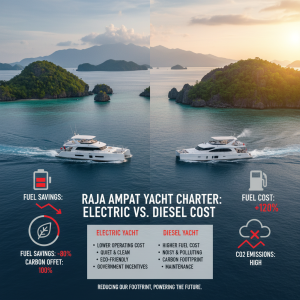
The conversation about the best time to visit must include the capabilities of your vessel. A journey aboard a state-of-the-art electric yacht fundamentally alters the equation. The stability and advanced navigation systems allow our captains to mitigate the effects of the windy season (May-September) by masterfully crafting itineraries that utilize the lee of the islands. While a traditional vessel might be confined to port, we can find perfectly sheltered bays and dive sites that remain calm and clear. The true advantage, however, is the silence. The underwater sound pollution from a conventional diesel engine can exceed 170 decibels, a level known to disrupt the communication and navigation of cetaceans and other marine life. Our electric propulsion operates at a level below 60 decibels, which is quieter than a normal conversation. This year-round benefit means that wildlife encounters are closer, more natural, and less intrusive. Whether it’s watching a pod of dolphins play at the bow in March or observing a rare bird of paradise in its treetop courtship ritual in July, the silent approach ensures the experience is authentic. This commitment to low-impact travel is essential for protecting the delicate biodiversity that earned Raja Ampat a place on UNESCO’s Tentative World Heritage List, ensuring its wonders persist for generations.
Marine Life Calendar: Timing Your Encounters
While Raja Ampat’s biodiversity is staggering year-round—it is, after all, the global epicenter of marine life with over 1,628 fish species—certain encounters are more likely during specific periods. The October to April dry season is, without question, the peak for oceanic manta rays. Their congregations at cleaning stations are a world-famous spectacle. This period also offers the highest probability of encountering large schools of fusiliers, surgeonfish, and barracuda, as the clear, calm water encourages massive aggregations. From May to September, while the mantas are less concentrated, the focus can shift. Our guides often find this a better time for spotting the elusive walking shark (epaulette shark) on night dives, as the slightly cooler water temperatures can alter their behavior. For cetacean lovers, pilot whales and various dolphin species are present year-round, though the calm seas of the dry season make spotting their dorsal fins and spouts significantly easier from the deck. Bryde’s whales are also occasionally sighted. As the official Indonesian tourism authority notes, the sheer density of life here is the main attraction, and no matter when you visit, you are guaranteed to witness a vibrant, thriving ecosystem unlike any other on Earth. A well-planned itinerary will always yield extraordinary wildlife moments.
Quick FAQ: Your Raja Ampat Timing Questions Answered
What is the absolute best month for diving?
If forced to choose one, most dive professionals I’ve spoken with point to March. It sits in the center of the dry season, offering a perfect balance of peak visibility, calm seas, and prolific marine activity, all while sitting just outside the main holiday rush of December and January.
How does the timing affect land-based excursions?
The dry season (October-April) is also optimal for land activities. The iconic trek up Pianemo or Wayag’s karst peaks is safer and more pleasant when the trails are not slick with rain. It’s also a better time for birdwatching, as the birds of paradise are often more active in their courtship displays during dry, sunny mornings.
Is there a “low season” for pricing?
The period from June to early September is typically considered the low season due to the windier conditions. While charter availability may be higher, it’s crucial to understand that itineraries during this time will be focused on the more protected northern and central areas. It’s not a “bad” time, but one that requires flexibility and expert guidance to maximize.
When should I book my trip for the peak season?
For a charter between December and March, we recommend booking 9 to 12 months in advance. The demand for high-quality vessels, especially unique platforms like our electric yachts, is exceptionally high, and prime dates are secured well ahead of time.
Ultimately, the “best time for an electric yacht trip to Raja Ampat” is a personal calculation, weighing the trade-offs between perfect seas, marine life spectacles, and the desire for solitude. While the months from October to April present the most idyllic conditions for most travelers, the truth is that this equatorial paradise offers profound beauty and adventure in every season. The silent, sustainable platform of our vessel ensures that no matter when you choose to explore these sacred waters, your journey will be one of intimate connection and minimal intrusion. The real luxury is having the freedom and expert guidance to follow the rhythms of the archipelago itself.
To begin crafting an itinerary that aligns with your vision and the optimal seasonal conditions, we invite you to speak with our expedition planners. Discover the unparalleled experience of an electric yacht Raja Ampat voyage and see this last paradise in a way that few ever will.