Updated: May 2026
The Ultimate Route Guide for an Eco-Friendly Yacht Charter in Raja Ampat
- It prioritizes Marine Protected Areas (MPAs) and no-anchor zones.
- The route leverages silent electric propulsion to minimize acoustic impact on marine life.
- It focuses on regulated dive sites and supports community-based tourism initiatives.
The hum is the first thing you notice—or rather, the lack of one. Aboard our vessel, the only sounds are the gentle lapping of water against the hull and the distant call of a Papuan hornbill. We are gliding through the Dampier Strait, the water a sheet of impossible turquoise, as the sun begins to warm the prehistoric karst spires that define Raja Ampat’s horizon. This is not just a vacation; it is a conscious immersion into the world’s most biodiverse marine ecosystem. Crafting the perfect eco-friendly yacht charter route guide for Raja Ampat is less about ticking off locations and more about choreographing a journey that honors the profound fragility of this last Eden. It’s about understanding that true luxury is leaving a place as pristine as you found it.
Charting a Course for Conservation: The Philosophy of an Eco-Conscious Itinerary
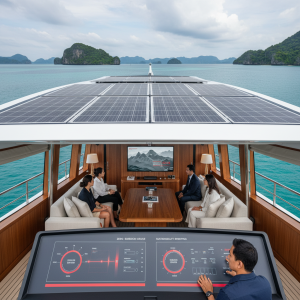
Before plotting a single waypoint on the navigation screen, it’s crucial to understand the stakes. Raja Ampat, or the ‘Four Kings,’ is an archipelago comprising over 1,500 small islands, cays, and shoals. According to UNESCO, its waters are home to more than 1,600 species of reef fish and 75 percent of the world’s known coral species—a concentration of life found nowhere else on the planet. For decades, the quintessential way to see this region was aboard a traditional wooden phinisi. While romantic, their diesel engines create noise and chemical pollution that can be detrimental to the very reefs visitors come to admire. The future of exploration here is electric. Our state-of-the-art electric yacht raja mpat charters operate on a philosophy of minimal disturbance. The near-silent electric propulsion system doesn’t just eliminate fumes; it drastically reduces underwater acoustic stress on cetaceans and other marine life. This allows for uniquely intimate encounters, from observing a pod of dolphins to approaching a manta ray cleaning station without causing alarm. This commitment extends beyond technology. A core tenet of our journeys is supporting the local conservation framework. Every guest is required to purchase a Raja Ampat Marine Park Entry Permit (known locally as a PIN), which costs IDR 700,000 (approximately $45 USD) and is valid for one year. This fee isn’t an administrative hurdle; it is a direct investment in the patrol boats, reef monitoring, and community programs that are vital for the archipelago’s survival.
Days 1-3: The Dampier Strait – Manta Rays and Avian Wonders
Our journey commences in Sorong, the bustling port city that serves as the primary gateway to the archipelago. The transition from urban energy to serene wilderness is astonishingly swift. Within an hour of leaving the harbor, the sounds of the city are replaced by the whisper of the wind as our vessel silently cuts through the water. The first destination is Kri Island, a site that holds a world record. It was here that marine biologist Dr. Gerald R. Allen identified an incredible 374 species of fish on a single dive. We spend the afternoon exploring the house reef, a kaleidoscope of color and movement. Day two is dedicated to the majestic reef manta ray (Manta alfredi). We cruise to Manta Sandy, a famed submerged reef that serves as a cleaning station. Here, mantas with wingspans of up to 5 meters congregate to have parasites removed by smaller wrasse. The silent approach of our eco-conscious charter allows us to observe this symbiotic ritual without disruption. Later, we visit Arborek, a village that has become a model for successful community-based tourism. We wander its sandy paths, meet the local artisans, and learn about their efforts to protect their ancestral waters. The day concludes with a sunset cruise towards Gam Island, positioning us for the next day’s adventure: ‘The Passage.’ This is a distinctive topographical feature—a narrow, river-like channel of seawater that separates the islands of Waigeo and Gam. Snorkeling here feels like drifting through a submerged canyon, its walls adorned with vibrant soft corals and sea fans, a world away from the open sea.
Days 4-6: The Fam Islands – Iconic Views and Pristine Reefs
Leaving the central strait behind, we navigate southwest towards the Fam Islands, a constellation of smaller, uninhabited limestone islets. The centerpiece of this region is Piaynemo. After a secure and careful mooring, a well-maintained wooden staircase of 320 steps leads to a viewing platform. From this vantage point, the quintessential Raja Ampat panorama unfolds: a striking mosaic of turquoise lagoons encircled by sharply eroded karst formations. My advice, which I share with all our guests, is to make this climb at first light. Watching the sunrise paint the sky from this perch, with only the sounds of the jungle awakening below, is a profound experience. The following day is devoted to what lies beneath the surface at a site called Melissa’s Garden. Named by the pioneering diver Max Ammer for his daughter, this dive site is a sprawling, shallow coral plateau. The sheer density of life is staggering. Vast fields of staghorn coral provide shelter for immense schools of orange anthias and yellow-tailed fusiliers, their collective movement like a living current. The coral coverage here consistently exceeds 80 percent, a testament to the area’s health and protected status. On our sixth day, we explore the Keruo Channel, a narrow passage between two islands that offers an exhilarating drift dive or snorkel. The current, which can reach up to 3 knots, carries you effortlessly along a vertical wall blanketed in purple and orange soft corals. It’s here that the expertise of our local Papuan dive guides becomes indispensable, as they time the entry perfectly with the tides for a safe and spectacular journey past schools of sweetlips and curious batfish.
Days 7-10: Misool – The Crown Jewel of Marine Biodiversity
The journey south to Misool is often an overnight passage, and it’s here that the beauty of electric propulsion truly shines. Cruising under a canopy of stars in near-total silence is an experience in itself. Misool is the southern of the ‘Four Kings’ and is widely regarded as the heart of Raja Ampat’s biodiversity. The entire area is a strictly enforced no-take zone, part of the 300,000-acre Misool Marine Reserve, a conservation initiative established in 2005 that has led to a documented 250 percent biomass recovery inside its borders. Our first days here are spent exploring the labyrinthine lagoons around Balbulol and Wayil. We trade the main yacht for kayaks and stand-up paddleboards, allowing us to navigate the narrow, serene waterways and discover hidden coves. Here, you can find ancient rock art, ochre-colored handprints and symbols painted on limestone cliffs thousands of years ago. The highlight for many divers is Magic Mountain, an offshore seamount that acts as a cleaning station for the much larger oceanic manta rays. It’s a pinnacle of marine life, where massive schools of jacks swirl in the current and pygmy seahorses cling to gorgonian fans. Accessing this world-class site requires careful planning and an Advanced Open Water certification. Nearby, we explore Boo Windows, an islet with two swim-through tunnels at its base, creating a spectacular underwater photo opportunity. Our final exploration in Misool is to one of the region’s sacred jellyfish lakes, a landlocked marine lake where millennia of isolation have rendered the resident jellyfish stingless, allowing for an ethereal snorkeling experience among the pulsating, harmless golden orbs.
The Sustainable Difference: Beyond the Route
An exceptional eco-friendly yacht charter is defined by more than its itinerary; it’s a holistic commitment to sustainability. This philosophy permeates every aspect of our operations. Before we even depart Sorong, our chef provisions at the local market, sourcing fresh fruit, vegetables, and spices directly from Papuan farmers. This not only ensures the highest quality ingredients but also reduces food miles and directly supports the local economy. Onboard, we enforce a strict zero-waste policy. There are absolutely no single-use plastics. All water is produced through an advanced reverse-osmosis system, and all waste is meticulously sorted, compacted, and transported back to the mainland for responsible disposal. As our Captain, a Sorong native named Budi, often says, “We don’t just work on this sea; we are part of it. The electric motor is quiet, it respects the spirits of the water and the creatures below. It is the modern way to honor our ancient traditions.” This connection is vital. We exclusively employ local Papuan crew and guides, whose generational knowledge of the tides, currents, and secret spots is invaluable. Furthermore, we actively participate in citizen science. Our dive logs, manta ray sightings, and coral health observations are shared with organizations like the Manta Trust and the Coral Triangle Center, contributing valuable data to the ongoing effort to protect this global treasure.
Quick FAQ for the Eco-Conscious Voyager
What is the best time of year for this yacht charter route?
The prime season for exploring Raja Ampat is from October to April. This period coincides with the dry northwest monsoon, which generally brings calmer seas, sunny skies, and phenomenal underwater visibility, often exceeding 30 meters. This makes for ideal diving, snorkeling, and cruising conditions.
How does an electric yacht handle the distances in Raja Ampat?
Our silent vessels operate on a sophisticated hybrid-electric system. For navigating through sensitive marine areas, approaching wildlife, and silent night passages, we rely entirely on the electric motor. For longer open-water crossings, such as the one to Misool, a highly efficient, low-emission generator engages to recharge the battery banks, ensuring safety and an unlimited range without compromising our low-impact ethos.
Are park fees included in the charter price?
Typically, the Raja Ampat Marine Park Entry Permit (PIN) is an additional cost of IDR 700,000 (about $45 USD) per person. We handle the procurement of these permits for our guests. This fee is non-negotiable and directly funds the conservation patrols and community programs that protect the archipelago. For more information on park regulations, the official Indonesia Travel website is an excellent resource.
What level of diving certification is required?
Raja Ampat offers incredible underwater experiences for all levels, from novice snorkelers to seasoned divers. However, to fully appreciate the dynamic conditions and deep pinnacles of certain world-class sites like Magic Mountain or Blue Magic, an Advanced Open Water certification with logged experience in currents is strongly recommended. Our onboard PADI-certified divemasters tailor every dive profile to the specific comfort and experience level of our guests.
The journey through Raja Ampat is transformative. It recalibrates your sense of scale, of time, and of nature’s intricate beauty. To witness this realm is a privilege, and to do so in a way that actively preserves its sanctity is a responsibility we embrace. This is not merely a trip; it is a new paradigm for exploration, where the pinnacle of luxury is found in the silence of an electric motor and the lightness of your footprint. To chart your own silent course through this aquatic Eden, explore the possibilities with Electric Yacht Raja Ampat. The last true wilderness on Earth is waiting, and it deserves to be seen—and heard—in a new light.